
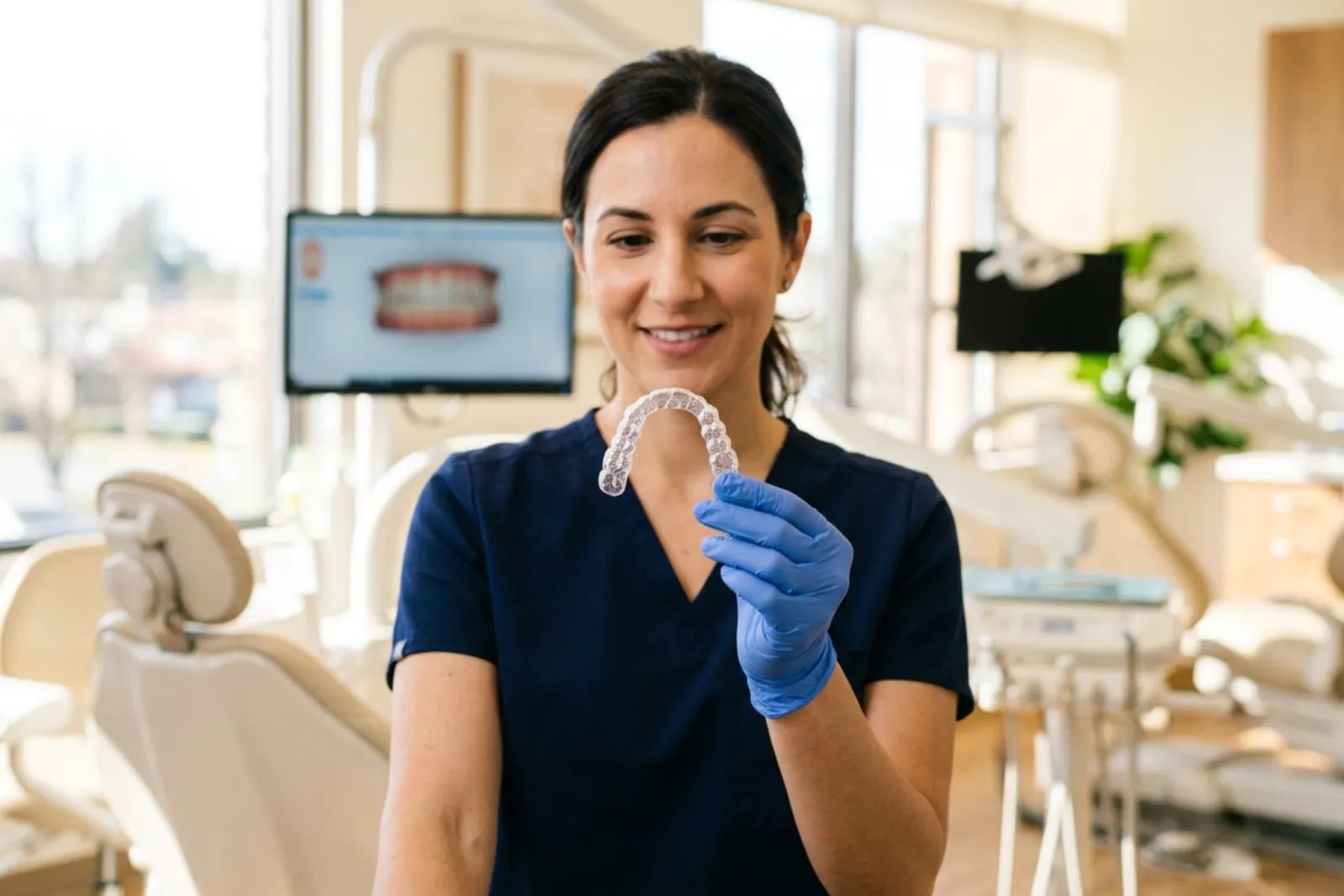
Clear aligners can seem simple at first: wear a series of transparent trays, change them on schedule, and watch your teeth move. The trays themselves are straightforward to use once you get comfortable with them. Behind that routine, though, is a treatment plan that needs clinical judgment, healthy supporting tissues, and ongoing monitoring.
Knowing what happens at each stage can make treatment feel less uncertain. It also helps you understand why consistent wear matters, why plans sometimes change, and why retainers remain important after the final active tray.
Whether you are considering Invisalign or another clear aligner system, the basic journey begins with an assessment of your teeth and bite. A digital preview comes later. Your oral health comes first.
Start With Your Health, Your Bite, and Your Goals
Clear aligners are custom-made, removable trays that guide teeth through a planned sequence of small movements. Instead of wires and brackets, they use the fit of the plastic, sometimes supported by attachments or other aids, to apply controlled pressure.
They are suitable for many orthodontic concerns, but they are not the right choice for every person or every movement. An in-person clinical assessment helps determine what is appropriate.
At this appointment, your clinician examines tooth alignment, how your upper and lower teeth meet, gum health, and other dental needs. X-rays may be needed to assess roots, bone support, or teeth that are not visible in the mouth. A surface scan cannot provide all of that information.
This is also the time to explain what bothers you and what you hope will change. Perhaps crowded lower teeth are difficult to clean. Maybe a gap makes you self-conscious. You may care more about improving your bite than changing your smile’s appearance.
Those priorities matter. So do the limits of treatment. Some concerns may require fixed braces, another approach, or care beyond orthodontics. Cavities and active gum disease generally need attention before teeth are moved.
Baseline photographs and records give the clinician a reliable starting point for later comparisons.
What the Digital Scan Does, and What It Cannot Promise
A digital scanner records the visible surfaces of your teeth and creates a three-dimensional model. For many patients, it replaces conventional impression materials.
Treatment-planning software then helps model proposed tooth movements. You may see an animation of teeth moving into new positions, which can make the plan easier to understand.
It is worth keeping one distinction clear: the animation is a proposal, not a guaranteed outcome.
Software does not know exactly how your tissues will respond. Your clinician must evaluate which movements are appropriate, how to sequence them, and whether additional techniques are needed. Some plans include small amounts of reshaping between teeth, called interproximal reduction, to create space. Others may use elastics or different treatment methods.
The plan includes an estimated schedule and an initial number of trays. Neither should be treated as a promise. For example, a plan might begin with 24 aligners, but additional trays could be prescribed later if certain teeth need more movement.
Keeping the scan date and initial plan in your records helps clarify what was proposed and what actually happened over time.
Why Teeth Need Time to Move
Teeth are anchored in living tissue. Around each root is a periodontal ligament, and beyond that is supporting bone.
Controlled orthodontic force prompts changes in these tissues. Bone is gradually resorbed in areas under pressure, while new bone forms elsewhere as the tooth moves. This remodeling process takes time, and its pace varies between people.
That is why moving through trays faster is not automatically better. The treatment schedule must allow for a biological response, not simply a change in tooth position on a screen.
Orthodontic movement also carries risks. Root resorption, which means shortening of tooth roots, can occur during treatment. Gum recession and other problems may be concerns in susceptible patients. Excessive or unsuitable forces can increase risks, so healthy gums and appropriate monitoring matter throughout care.
You cannot control every aspect of that response. You can, however, follow wear instructions, maintain oral hygiene, and attend reviews so problems are identified early.
Your Fitting Appointment and Attachments
When your aligners are ready, the fitting appointment checks that they seat correctly and that you can insert and remove them safely. Your clinician should explain when to change trays, how long to wear them each day, and how to care for them.
Some treatment plans require small tooth-colored attachments bonded to selected teeth. These give the aligners a better grip and help produce particular movements, such as rotating a tooth or controlling its position.
Attachments can be more noticeable than patients expect. Their visibility depends on their size, location, and the way light catches them. They may remain for part or all of active treatment, and their placement should be recorded.
Before leaving, practice removing and reinserting your trays. Ask what a properly seated aligner should look like and how to recognize a fit problem.
A little hands-on practice is useful. The first removal can feel awkward, especially around attachments, but it usually becomes easier with experience.
Making Daily Wear Manageable
A common instruction is to wear aligners for about 22 hours each day, removing them for meals and cleaning. Your own clinician’s directions take priority because schedules can differ.
That leaves a fairly small window for eating, drinking, and oral care. Frequent snacking or sipping coffee over several hours may need some adjustment.
The routine is manageable for many people, but it deserves an honest look before treatment begins. Removable trays give you flexibility. They also place much of the daily responsibility in your hands.
A few habits make that responsibility easier:
Remove aligners before eating or drinking anything other than plain water.
Brush before reinserting them when possible, and clean between your teeth daily.
Clean trays using the method your clinician recommends, avoiding hot water that can distort the plastic.
Keep trays in their case whenever they are out of your mouth.
Change aligners only according to your prescribed schedule.
Wrapping aligners in a napkin is a surprisingly easy way to lose them. A protective case is worth carrying, even for a short meal away from home.
If brushing is temporarily unavailable, rinse your mouth and trays, then clean your teeth properly as soon as practical. Ask your clinician how to handle this without repeatedly sacrificing wear time.
What if you miss wear time?
It happens. A long event, illness, or a misplaced tray can interrupt the routine.
Extended time without aligners can affect fit and progress. Contact your clinician for advice rather than moving ahead, doubling up, or changing the schedule yourself. Tell them which tray you are wearing, how long it was out, and whether it still seats fully.
An accurate account helps them decide what to do next. There is no benefit in understating missed wear.
Pressure, soreness, and speech changes
New aligners may cause temporary pressure or soreness, particularly during the first few days of a tray. The amount varies by person and treatment stage.
A slight lisp can also happen while your tongue adapts. Reading aloud may help you become comfortable speaking with the trays in place.
Severe or persistent pain, swelling, a sharp edge causing an ongoing sore, or an aligner that will not seat deserves a call. You do not need to push through symptoms that seem unusual.
Monitoring Progress and Adjusting the Plan
Changing trays at home does not replace clinical monitoring. Review appointments let the clinician assess your bite, oral health, aligner fit, and whether teeth are following the planned movements. Appointment intervals depend on your case.
You may hear the word “tracking.” It describes how closely the teeth are following the intended positions as treatment progresses. A persistent gap between a tooth and its aligner can be a reason to check the fit.
Dated photographs taken in consistent positions help show changes more reliably than casual selfies. Updated scans may also be useful. These records can be compared with the original plan, including the number of trays prescribed and the number actually completed.
Your reported wear time provides useful context, but it is still self-reported rather than independently verified. Pauses, lost trays, attachment repairs, or altered wear schedules should be recorded too.
Why refinements may be needed
Some teeth do not move exactly as predicted, even when a patient follows instructions carefully. Biological variation and the complexity of a movement can both affect progress.
Refinement aligners are additional trays prescribed to address remaining movements or revised goals. They may require a new scan and changes to attachments.
Needing refinements does not automatically mean that anyone did something wrong. It means the actual response needs to be compared with the plan.
Still, the change should be explained. Ask which movements remain, why more trays are recommended, and how the estimated schedule will change. The need for refinements, and their number, cannot be known in advance for every patient.
Finishing Active Treatment Is a Clinical Decision
Reaching the end of a box of aligners is a milestone, but it does not by itself establish that treatment is complete.
Your clinician needs to assess the final tooth positions, bite, and remaining concerns. Together, you can review how closely the result meets the original goals and whether further movement is appropriate.
This is a good time to raise anything that still feels uncomfortable or unclear. Cosmetic concerns matter, but so does how your teeth meet when you bite and chew.
Once active treatment is complete, attachments are removed when appropriate, and the retention plan begins.
Retainers Protect the Progress You Have Made
Teeth can shift after orthodontic treatment. Surrounding tissues need time to adapt, and natural changes in tooth position can continue throughout life.
Retainers help maintain the new positions. They may be removable, bonded behind selected teeth, or used in combination. The best choice depends on your needs and your clinician’s assessment.
Before finishing treatment, make sure you understand your retainer type, wear schedule, cleaning instructions, and follow-up arrangements. Long-term retention is commonly recommended, though individual schedules vary.
Removable retainers can wear out, crack, or become distorted. Bonded retainers can loosen and need careful cleaning around the wire. Neither should be assumed to last indefinitely without checks.
If a retainer suddenly feels unusually tight, no longer fits, or breaks, contact your clinician promptly. Do not force an ill-fitting appliance into place. Early advice may prevent a small problem from becoming a larger setback.
What a Helpful Patient Case Should Show
Before-and-after photographs can be encouraging, but they tell only part of the story.
A useful educational case explains the starting concerns, assessment findings, scan date, and treatment goals. It then follows the sequence through attachments, progress reviews, any interruptions, refinements, and retention.
Planned tray counts should be distinguished from completed counts. Reported wear time should be identified as the patient’s account. Photographs should be dated and standardized where possible, and digital simulations should be clearly separated from actual results.
Using a patient’s photographs, scans, or treatment details for education requires documented informed consent. Patients should understand what will be shared and for what purpose.
Most importantly, one person’s outcome cannot predict yours. Their case can help you understand the process, but it cannot establish your treatment length, final result, or need for additional trays.
Clear aligner treatment works best when the plan stays connected to the person wearing the trays. Careful assessment starts that process. Consistent wear, honest conversations, clinical reviews, and ongoing retention help carry it through.